
Introduction: A Smarter Way to Control Pressure Without External Energy
In industries such as oil & gas, chemical processing, power generation, and HVAC systems, stable pressure control is critical to ensure safety, product quality, and energy efficiency.
However, many real-world applications face a common challenge:
No access to electricity or compressed air
This is where the self-operated pressure regulating valve becomes the ideal solution.
Without any external power supply, it uses the energy of the process medium itself to automatically regulate pressure—making it a reliable, energy-saving, and maintenance-friendly choice for modern industrial systems.

What Is a Self-Operated Pressure Regulating Valve?
A self-operated pressure regulating valve is a type of control valve that operates independently of external energy sources.
Instead of relying on electric or pneumatic actuators, it uses:
- Process pressure
- Flow changes
- Temperature variations
to automatically maintain a preset pressure value.
In simple terms, it acts like a built-in intelligent pressure controller, integrating:
- Sensing
- Control
- Actuation
into one compact unit.

How Does a Self-Operated Pressure Regulating Valve Work?
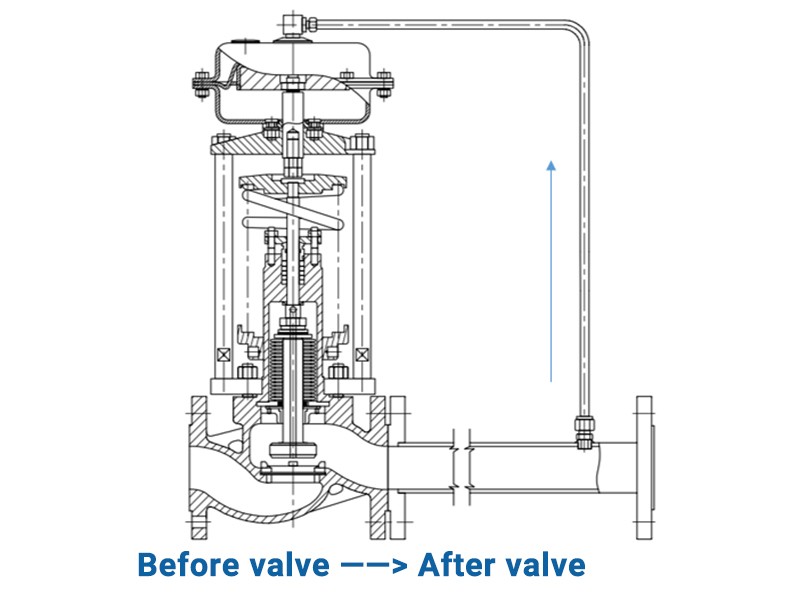
1. Downstream Pressure Control (Type B) – Most Common
This type is designed to maintain stable outlet pressure (P2).
Working principle:
- The outlet pressure is fed back to the diaphragm
- It balances against the spring force
- Valve opening adjusts automatically
Control logic:
- Pressure increases → valve closes
- Pressure decreases → valve opens
Ideal for:
- Steam systems
- Water supply
- Industrial pipelines
2. Upstream Pressure Control (Type K) – Safety Protection
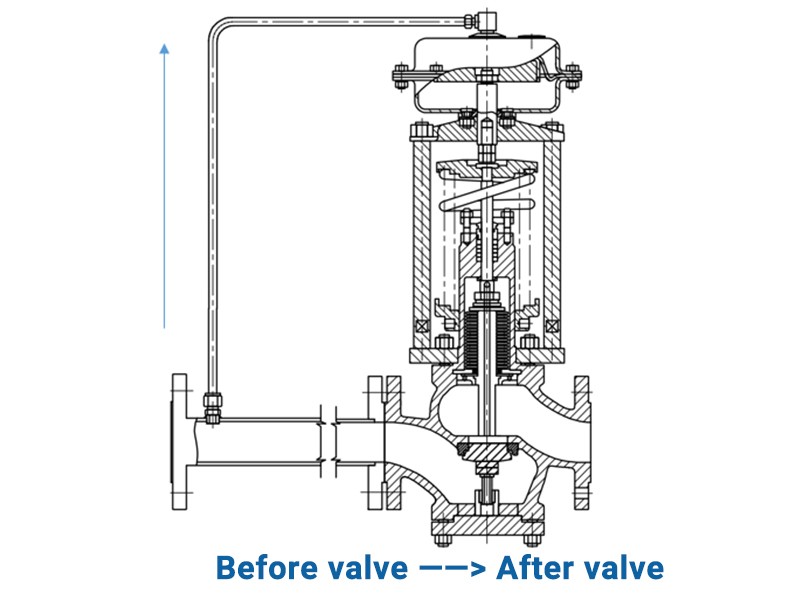
This type controls inlet pressure (P1) and is mainly used for pressure relief and protection.
Working principle:
- Inlet pressure acts on the diaphragm
- When pressure rises → valve opens to release excess pressure
- When pressure drops → valve closes
Ideal for:
- Boiler systems
- High-pressure pipelines
- Equipment protection
Direct-Acting vs Pilot-Operated Designs
-
- Direct-acting valves:
- Simple structure
- Fast response
- Lower cost
- Pilot-operated valves:
- Higher accuracy
- Better for complex systems
- Direct-acting valves:
Suitable for larger flow conditions
Why Choose a Self-Operated Pressure Regulating Valve?
✔ No External Power Required
No electricity. No compressed air.
Perfect for remote or hazardous environments.
✔ Energy Saving & Cost Efficient
Eliminates energy consumption from actuators and control systems.
✔ Easy Installation
No complex wiring or air piping required.
✔ Low Maintenance
Fewer components mean lower failure rates and reduced downtime.
✔ Automatic Operation
Set the pressure once—let the valve handle the rest.

Technical Specifications
- Size Range: DN15 – DN300
- Temperature: Up to 350°C
- Pressure Ratio: Up to 10:1
- Accuracy: ±5% to ±10%
Material Options
- Body: Carbon steel / Stainless steel
- Trim: Stainless steel
- Packing: PTFE / Graphite
Structure Types
- Diaphragm type
- Piston type
- Bellows type
Typical Applications
Downstream Pressure Regulation (Type B)
- Steam distribution systems
- Water supply networks
- Chemical processing lines
- HVAC systems
Maintains stable downstream pressure
Upstream Pressure Protection (Type K)
- Boilers
- Industrial equipment protection
- High-pressure systems
Prevents overpressure damage
How to Choose the Right Self-Operated Pressure Regulating Valve
Step 1: Define Your Goal
- Need stable outlet pressure → Type B
- Need pressure relief protection → Type K
Step 2: Check Operating Conditions
- Pressure range
- Temperature
- Medium type (steam, liquid, corrosive)
Step 3: Select Proper Size
- Match DN size with pipeline
- Avoid oversizing (causes instability)
- Avoid undersizing (limits flow)
Step 4: Choose Structure Type
- Diaphragm → general use
- Piston → higher pressure
- Bellows → sensitive applications
Installation Tips for Optimal Performance
- Install valve vertically on horizontal pipelines
- Ensure flow direction matches arrow marking
- Install pressure gauges upstream and downstream
- Keep impulse lines properly positioned
- Add filter for dirty media
- Use condenser for steam applications
Common Problems and Solutions
Problem: Pressure Cannot Reach Set Value
Possible causes:
- Weak spring
- Blockage
- Internal leakage
Solution:
- Replace spring
- Clean valve
- Repair sealing
Problem: Pressure Cannot Be Reduced
Possible causes:
- Spring too strong
- Valve too small
Solution:
- Adjust spring
- Select larger valve
Problem: Pressure Fluctuation
Possible causes:
- Oversized valve
- Insufficient actuator capacity
Solution:
- Resize valve
- Add damping device
Conclusion: Reliable Pressure Control Without Complexity
A self-operated pressure regulating valve is more than just a valve—
it’s a self-sufficient pressure control solution.
With no external energy required, it delivers:
Stable performance
Lower operational costs
Reduced maintenance
High reliability
Making it the ideal choice for both traditional and modern industrial systems.
