Product Summary
The PTFE Lined Quantitative Sampling Valve is designed for safe, accurate, and repeatable sampling of highly corrosive liquids in industrial pipelines. Featuring a 304 or 316L stainless steel body, F4 or F46 fluoropolymer lining, an integrated metering chamber, and manual handle operation, it enables controlled sample collection without interrupting normal production. The fully lined flow passage provides excellent corrosion resistance, while the enclosed sampling design helps minimize leakage and operator exposure. Available in DN25–DN80 sizes with customizable sampling volumes of 5 mL, 10 mL, 20 mL, and 50 mL, it is suitable for chemical processing, pharmaceutical manufacturing, dye production, agrochemical processing, and wastewater treatment applications.
1. Product Overview
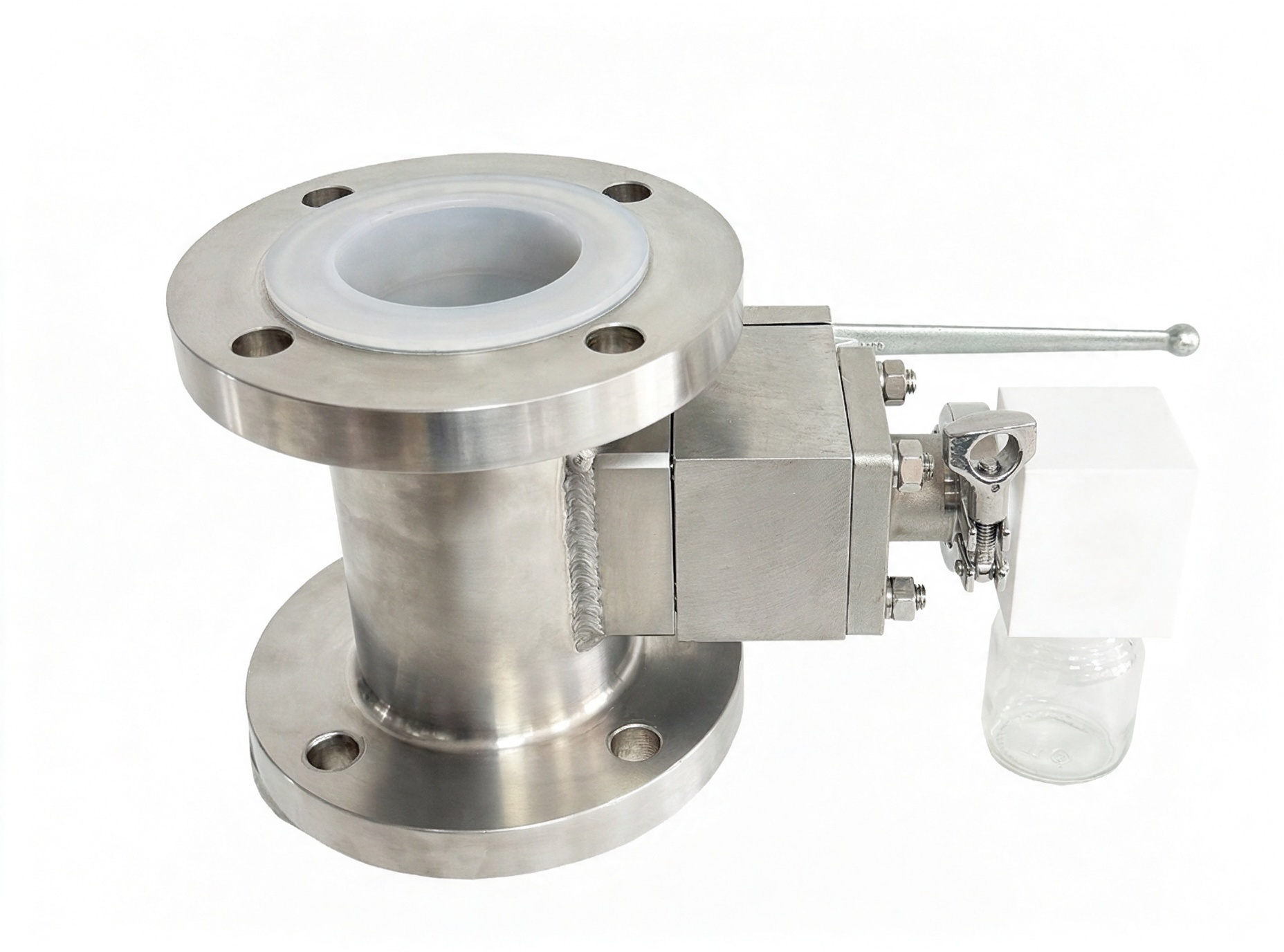
The PTFE Lined Quantitative Sampling Valve is a specialized enclosed sampling device designed for industrial process piping systems. The valve features a fully fluoropolymer-lined flow passage and a manual handle mechanism that enables controlled collection of a fixed volume of process media.
The valve can be directly connected to a compatible sampling bottle, allowing safe sample collection from pressurized pipelines without interrupting normal production operations.
Its integrated metering chamber provides consistent sampling volumes and reduces variations associated with manual sampling methods.
Designed for demanding corrosive chemical environments, the valve is widely used in industrial processes requiring reliable, enclosed, and repeatable liquid sampling.
2. Structural Features
- Stainless Steel Body with Fluoropolymer Lining: The valve features a stainless steel body with a fully lined internal flow passage. All wetted surfaces are protected by fluoropolymer materials to minimize direct contact between corrosive fluids and metal components.
- Integrated Metering Chamber: The built-in fixed-volume sampling chamber allows precise sample collection through manual handle position switching, completing the filling and discharge process in a single operating cycle.
- Quick-Connect Sampling Outlet: The sampling outlet features a quick-clamp connection compatible with suitable sampling bottles, allowing convenient installation, removal, and replacement.
- Flanged Pipeline Connection: The valve connects to the main process pipeline through flanged connections. The flanged flow passage is internally lined to provide continuous corrosion protection.
- Reliable PTFE Sealing: Corrosion-resistant PTFE sealing components provide effective sealing and reliable performance in compatible chemical processing applications.
- Compact Stainless Steel Construction: The valve features a compact design with stainless steel external components, providing structural strength, corrosion resistance, and convenient installation and maintenance.
3. Key Advantages
Consistent Quantitative Sampling
The integrated metering chamber provides a fixed sampling volume for each operation, minimizing variations caused by manual sampling and supporting standardized laboratory testing.
Excellent Chemical Resistance
The fully lined internal flow passage provides resistance to a wide range of corrosive chemicals, including strong acids, strong alkalis, and compatible salt solutions.
Enclosed Sampling for Improved Safety
The sealed sampling structure helps minimize fluid leakage, splashing, and operator exposure to hazardous process media.
Simple Manual Operation
The handle-operated switching mechanism allows a single operator to complete the sampling process conveniently without external power or compressed air.
Convenient Sampling Bottle Replacement
The quick-connect sampling outlet enables fast installation and removal of sampling bottles, reducing maintenance time and improving sampling efficiency.
Reduced Sample Contamination
The enclosed sample collection process helps protect samples from external contamination, supporting more reliable analytical testing.
Suitable for Continuous Production
The valve allows online sampling from pressurized industrial pipelines without interrupting normal production under suitable operating conditions.
4. Technical Specifications
| Parameter | Specification |
|---|---|
| Product Type | PTFE Lined Quantitative Sampling Valve |
| Nominal Diameter | DN25–DN80 |
| Nominal Pressure | PN10 / PN16 / PN25 |
| Valve Body Material | 304 / 316L Stainless Steel |
| Internal Lining Material | F4 (PTFE) / F46 (FEP) |
| Sealing Material | PTFE |
| Pipeline Connection | Flanged Connection |
| Sampling Outlet | Quick-Clamp Connection |
| Operation Method | Manual Handle Switching |
| Sampling Volume | 5 mL / 10 mL / 20 mL / 50 mL (Customizable) |
| Operating Temperature | -20°C to +180°C (Depending on Lining Material) |
| Sampling Container | Compatible Sampling Bottle |
| Customization Options | Sampling Volume and Connection Size |
5. Applicable Media
The PTFE Lined Quantitative Sampling Valve is designed for sampling compatible corrosive liquids, including:
- Strong Acid Solutions
- Strong Alkaline Solutions
- Corrosive Salt Solutions
- Certain Organic Solvents
- Other Compatible Corrosive Process Liquids
Chemical compatibility should be evaluated based on the specific medium, concentration, operating temperature, and pressure.
6. Industrial Applications
The valve is widely used in industrial process pipelines requiring reliable and standardized sampling of corrosive liquids, including:
- Fine Chemical Processing
- Pharmaceutical Manufacturing
- Dye and Pigment Production
- Agrochemical Manufacturing
- Wastewater Treatment
- Corrosion-Resistant Chemical Processing Systems
- Industrial Process Monitoring
- Laboratory Quality Control and Testing
It is particularly suitable for online sampling from pressurized pipelines where consistent sampling volumes and reliable chemical resistance are required.
The valve is not recommended for liquids containing large quantities of hard solid particles, as abrasive particles may damage the internal lining and sealing surfaces.
It is also unsuitable for highly viscous media that crystallize easily, as crystallization may cause the valve core to become stuck and interfere with normal metering chamber operation.