Ⅰ.Product Introduction
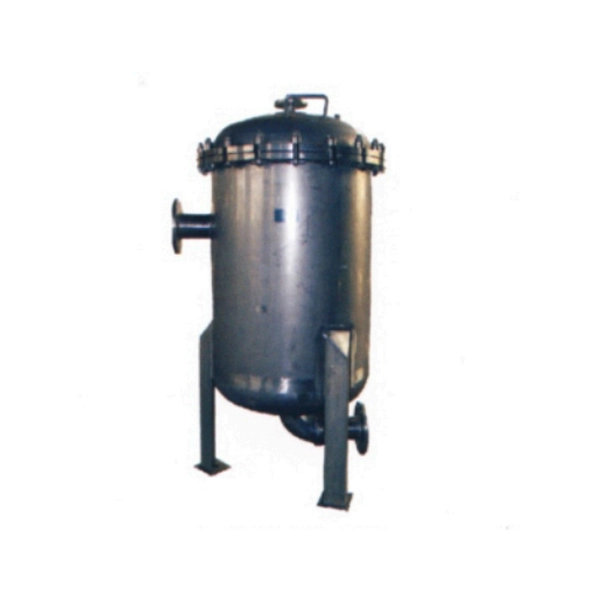
The JM-DS series bag filter is a high-performance filtration equipment designed for precise filtration of gases and liquids in various industrial scenarios. It adopts a modular structural design, which can be flexibly configured according to actual application needs. The equipment is mainly divided into two categories based on the feeding method: top-in type (Type D) and side-in type (Type C). In terms of structural types, it covers single-bag type, multi-bag type, and double type (S type), providing diversified choices for different flow rates, pressure requirements, and continuous operation needs. The filter can be equipped with filter elements and shell structures of different materials and specifications according to the physical and chemical properties of the filtered medium (such as corrosion, temperature, viscosity, etc.), ensuring stable and efficient filtration effects in complex working conditions. It is widely used in water treatment, chemical industry, adhesive, lubricating oil, automobile manufacturing, aluminum manufacturing and other fields, and plays a key role in medium purification, impurity removal, material recovery and other links.
Ⅱ.Product Features
1. Classification by Feeding Method & Core Features
Top-in Type (Type D)
-
Adopts a multi-group eye bolt locking design, which ensures the tightness of the filter body, effectively prevents medium leakage, and improves the safety and stability of the equipment during operation.
-
The filter bag has strong pressure resistance, which can withstand the water hammer impact of 0.9MPa, and has good adaptability to sudden pressure changes in the system, reducing the damage risk of the filter bag and extending its service life.
-
The top-in feeding design makes the medium flow more evenly through the entire filter bag surface, avoiding local overload of the filter bag caused by uneven flow, ensuring full utilization of the filter bag and improving filtration efficiency.
Side-in Type (Type C)
-
Flexible flow direction options: it can be configured as side-in & side-out or side-in & bottom-out according to on-site installation space and process requirements. The disassembly process is simple and convenient, reducing the time cost of maintenance and filter bag replacement.
-
Multi-bag configuration available: supports 2-8 filter bag loading combinations, which can meet the filtration needs of large flow rate scenarios, and the flow rate can be flexibly matched according to the actual process requirements.
-
Double-type (S type) structure: specially designed for continuous filtration requirements, it can realize non-stop filtration and maintenance (such as filter bag replacement) through alternate operation of two filter units, ensuring the continuity of the production process and improving production efficiency.
-
Diversified structural options: optional heat preservation and heating jacket structures, which are suitable for filtration scenarios of mediums that are easy to solidify or have strict temperature requirements, ensuring the fluidity and filtration effect of the medium.
-
Multiple cover-opening methods: including open type and open translation type, which can be selected according to the on-site operation space and maintenance habits, making the operation more convenient.
-
Flexible bracket designs: optional live sleeve lifting type and mobile type, which facilitate the installation, movement and maintenance of the equipment, and improve the adaptability of the equipment to different on-site environments.
-
Customizable combination: can be combined with on-board pumps and equipped with installation platforms, which need to be reserved in advance according to user needs to meet the integrated application requirements of the whole set of filtration systems.
2. General Product Advantages
-
Wide applicability: suitable for both gas and liquid media, and can be adapted to various complex medium properties through the selection of different materials.
-
Strong material compatibility: the shell and filter materials are available in multiple options, which can effectively resist the corrosion of different media and ensure the service life of the equipment.
-
High filtration precision: matched with high-quality filter materials, it can achieve precise filtration of impurities, meeting the strict purity requirements of different industries for media.
-
Simple operation and maintenance: the overall structural design is humanized, the disassembly and assembly of filter bags is quick, and the daily maintenance workload is small.
Ⅲ.Technical Data Summary
Basic Technical Parameters
|
Item
|
Specification
|
|---|---|
|
Product Name
|
Mounted Filter
|
|
Model
|
JM-DS
|
|
Applicable Medium
|
Gas, Liquid
|
|
Shell Material
|
Carbon Steel, Stainless Steel
|
|
Filter Material
|
PP (Polypropylene), PFPE (Perfluoropolyether), PE (Polyethylene)
|
|
Connection Mode
|
Flange (Note: The original “Fricket” is presumed to be a typo, corrected to “Flange” according to industry common standards)
|
|
Flange Pressure Rating
|
0.25-6.3MPa, 150-300LB
|
|
Flange Sealing Surface
|
RF (Raised Face), MFM (Male-Female Face), RJ (Ring Joint), TG (Tongue and Groove)
|
|
Gasket Material
|
PTFE (Polytetrafluoroethylene), Metal Spiral Wound, Crystalline Rubber
|
|
Flow Rate
|
To be determined according to the number of filter bags, filter accuracy and medium properties (provided by the user)
|
User-Provided Parameters (for Customized Configuration)
To ensure the filter is perfectly matched with the user’s on-site process, the following parameters need to be provided by the user when placing an order:
-
Medium Temperature: The operating temperature of the filtered medium, which is used to select the appropriate shell, filter bag and gasket materials.
-
On-Stream Pressure: The working pressure of the system during filtration, which determines the pressure rating of the filter shell and flange.
-
Filter Accuracy: The required impurity removal precision, which is the key basis for selecting filter materials and filter bag specifications.
-
Medium Viscosity: The viscosity of the filtered medium, which affects the design of the flow channel and the selection of the number of filter bags, ensuring the normal flow rate and filtration efficiency.
Typical Application Fields
-
Water Treatment: System purification in cooling devices; filtration of oilfield water injection and well-free liquid; recovery of ion exchange resin in power plant condensing purifiers.
-
Chemical Industry: Recovery of catalysts in decarbonization inks; filtration of filter aids.
-
Adhesive Industry: Filtration of acrylic adhesives and gels; removal of PVC condensation blocks in hot-melt polymer filtration.
-
Lubricating Oil Industry: Pre-packaging filtration of lubricating oil tanks; filtration of lubricating oil injection filter aids.
-
Automobile Manufacturing: Electrophoretic paint filtration; hardener filtration; solvent filtration; filtration before product packaging.
-
Aluminum Manufacturing: Removal of sediment in phosphate tanks; removal of impurities in simple reservoirs and electrolytic stability tanks.
Ⅳ.The main shape and connection size
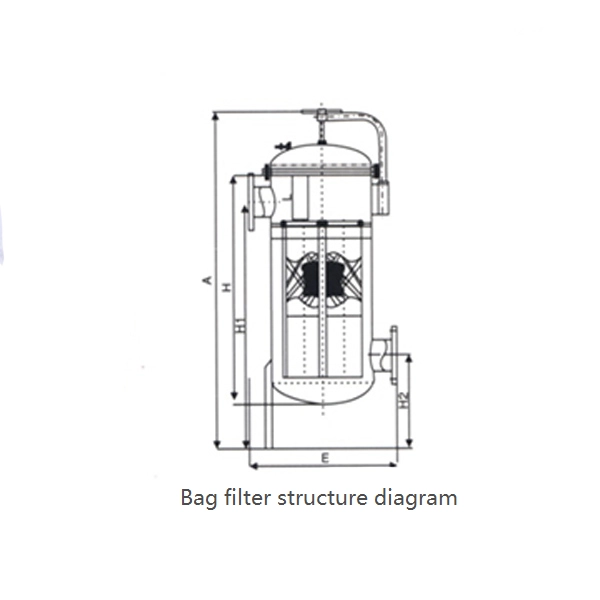
| Sa model | Overspeed size | flux | |||||||||
| d | h | Dφ | H | H1 | H2 | L | E | DN | A | Qm3/h | |
| 180/400-1-F | 170 | 360 | 219 | 600 | 735 | 340 | 150 | 350 | 40 | 40 | 18 |
| 180/800-1-F | 170 | 360 | 219 | 1000 | 1135 | 340 | 150 | 350 | 50 | 50 | 35 |
| 180/800-2-F | 170 | 360 | 400 | 1096 | 1225 | 410 | 325 | 560 | 100 | 100 | 70 |
| 180/800-3-F | 170 | 760 | 450 | 1112 | 1215 | 440 | 215 | 650 | 125 | 125 | 105 |
| 180/800-4-F | 170 | 760 | 500 | 1135 | 1230 | 460 | 239 | 740 | 150 | 150 | 140 |
| 180/800-6-F | 170 | 760 | 500 | 1220 | 1275 | 505 | 505 | 900 | 200 | 200 | 210 |