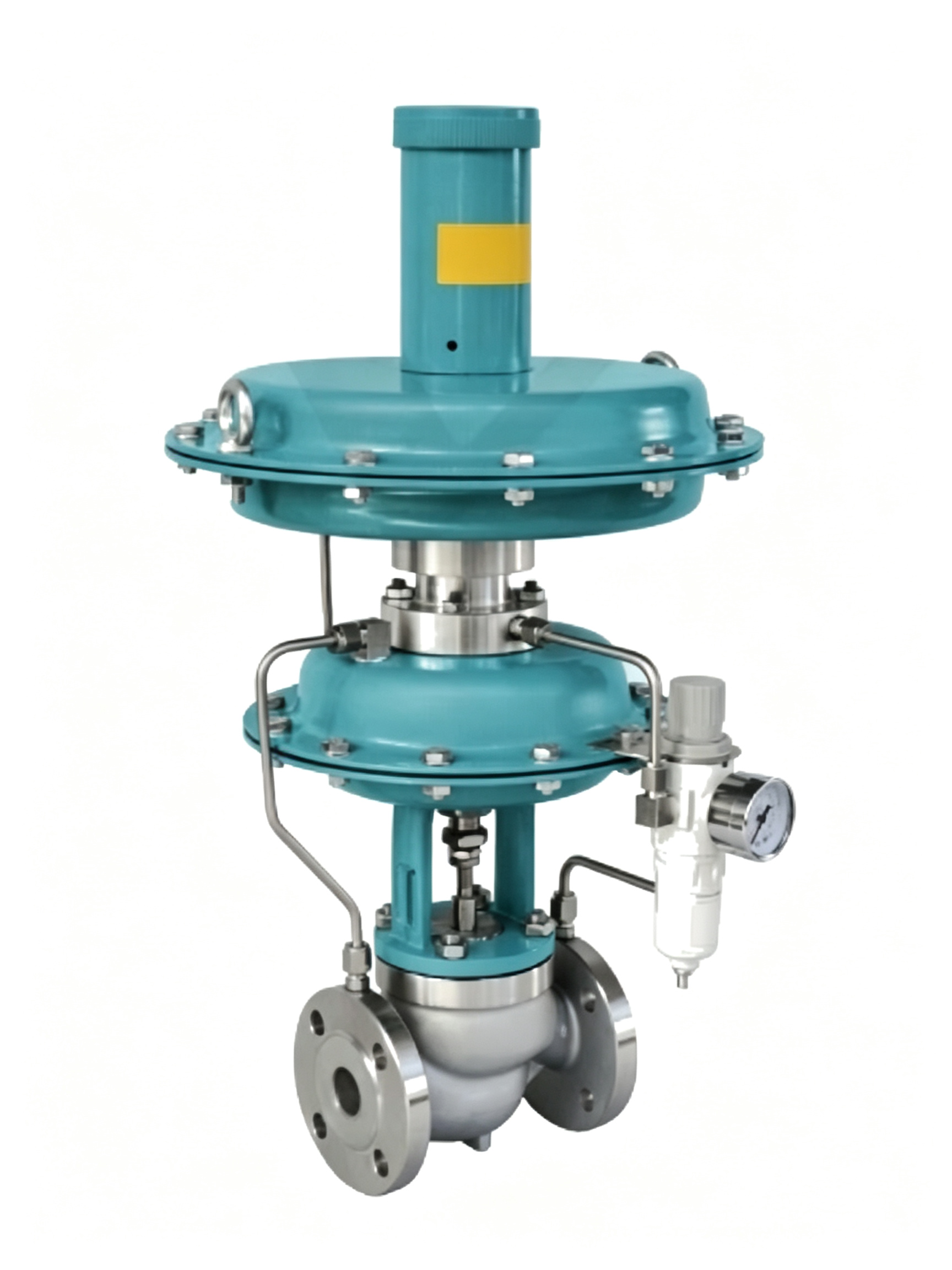
ZZYVP Self-Operated Nitrogen Seal Control Valve
1. Product Overview
1.1 Product Description
The ZZYVP Self-Operated Nitrogen Seal Control Valve is designed for maintaining a stable protective gas pressure, normally nitrogen, in storage tanks and process vessels.
The system is mainly composed of the control valve, actuator, controller and pressure spring. By maintaining a slight positive pressure inside the tank, the ZZYVP helps isolate stored media from direct contact with atmospheric air.
It is particularly suitable for large storage tanks where nitrogen blanketing is required to help reduce material evaporation and oxidation while supporting safe tank operation.
1.2 Application Purpose
The ZZYVP is primarily used in nitrogen blanketing systems where very low and stable tank pressure must be maintained.
When tank pressure falls, the nitrogen supply valve opens to replenish nitrogen. When the pressure reaches the required level, the valve regulates the supply accordingly, helping maintain the required protective atmosphere inside the tank.
2. Product Features
2.1 Self-Operated Design
The ZZYVP does not require an external power or air supply for normal regulating operation.
This allows it to operate in locations without electricity or instrument air, helping simplify the nitrogen blanketing system and reduce auxiliary energy requirements.
2.2 Micro-Pressure Regulation
The valve is specifically designed for low-pressure and micro-pressure control.
According to the catalog, the available pressure-setting range extends from approximately 0.4 kPa up to 66 kPa, allowing the valve to be configured for different tank blanketing requirements.
2.3 Sensitive Pressure Response
The actuator uses a large effective diaphragm area together with a low-stiffness setting spring.
This configuration provides sensitive response to small pressure changes and helps maintain stable tank pressure under varying operating conditions.
2.4 Pilot-Operated Pressure Reduction
The nitrogen supply section adopts a pilot-operated structure.
The catalog specifies a pressure reduction ratio of up to 100:1, providing effective pressure reduction and supporting accurate micro-pressure control.
2.5 Low-Friction Valve Design
The valve adopts a packing-free design that reduces friction acting on the valve stem.
Lower mechanical resistance improves response speed and contributes to better regulating accuracy.
2.6 Suitable for Continuous Production
Nitrogen supply pressure and discharge pressure can be set according to operating requirements, and adjustment can be carried out under continuous production conditions.
This helps minimize interruption to normal tank operation.
3. Working Principle
3.1 Tank Pressure Detection
The ZZYVP continuously senses pressure changes inside the storage tank through its diaphragm actuator.
3.2 Nitrogen Supply
When tank pressure decreases below the required setting, the nitrogen supply valve opens and introduces nitrogen into the tank.
As the tank pressure returns toward the set value, the valve adjusts the nitrogen flow automatically.
3.3 Excess Pressure Protection
When tank pressure rises to the preset discharge pressure, the corresponding pressure-relief arrangement opens to release excess pressure.
The catalog also recommends installing a breathing valve on the tank top as part of the storage-tank safety arrangement.
3.4 Inlet Pressure Requirement
The catalog notes that the micro-pressure regulating valve is intended for pressure below approximately 0.1 MPa.
Where the available nitrogen supply pressure is higher, an upstream ZZYP pressure regulating valve should be used to reduce the supply pressure before it enters the ZZYVP nitrogen blanketing valve.
4. Technical Parameters
4.1 Basic Specifications
| Parameter | Specification |
|---|---|
| Product Model | ZZYVP |
| Product Type | Self-Operated Nitrogen Seal Control Valve |
| Nominal Size | DN20–DN150 |
| Nominal Pressure | PN1.0 / PN1.6 MPa |
| Pressure Setting Range | 0.4–66 kPa |
| Applicable Temperature | -30°C to 150°C |
| Flow Characteristic | Quick Opening |
| Adjustment Precision | ≤5% |
| Connection | Flange |
| Valve Body Type | Straight Casting Valve |
| Leakage Class | ASME B16.104 Class V, Soft Seat / Class IV, Hard Seat |
The technical specifications are taken from the ZZYVP data table in the catalog.
4.2 Pressure Setting Ranges
Available pressure-setting ranges include:
0.4–0.5 kPa, 5–10 kPa, 9–14 kPa, 13–19 kPa, 18–24 kPa, 22–28 kPa, 27–33 kPa, 36–44 kPa, 42–51 kPa, 49–58 kPa and 56–66 kPa.
These segmented ranges allow the valve to be matched more closely to the required tank blanketing pressure.
4.3 Flow Capacity
Rated Kv values listed in the catalog range from:
Kv 3.2 to Kv 400
depending on valve seat diameter and valve size.
Correct sizing should be based on nitrogen flow demand, inlet pressure, required tank pressure and actual operating conditions.
5. Materials
5.1 Valve Body
Available materials:
- WCB
- 304 Stainless Steel
- 316 Stainless Steel
- 316L Stainless Steel
5.2 Valve Trim
Valve seat, spool and stem materials:
- 304
- 316
- 316L
5.3 Actuator
Galvanized steel sheet
5.4 Diaphragm
Available diaphragm materials:
- NBR
- EPDM
- Fluorine rubber
Material selection should be determined according to process medium, temperature and operating environment.
6. Applications and Customer Benefits
6.1 Storage Tank Nitrogen Blanketing
The ZZYVP is suitable for large storage tanks and vessels requiring a controlled nitrogen atmosphere above the stored medium.
6.2 Reduced Oxidation
Maintaining a nitrogen atmosphere helps reduce direct contact between the stored product and atmospheric oxygen, which can help limit oxidation of sensitive materials.
6.3 Reduced Material Evaporation
Maintaining stable tank-top pressure and a protective gas layer helps reduce direct exposure of volatile media to the atmosphere and supports better containment of stored materials.
6.4 Stable Low-Pressure Control
Sensitive diaphragm detection and pilot-operated regulation allow the system to respond to relatively small pressure changes, helping maintain stable tank blanketing pressure.
6.5 Simplified System Operation
Because the valve is self-operated, the system can function without an additional electrical or pneumatic control source for normal regulating operation.
This can simplify installation and support reliable operation in storage facilities where a straightforward nitrogen blanketing solution is required.