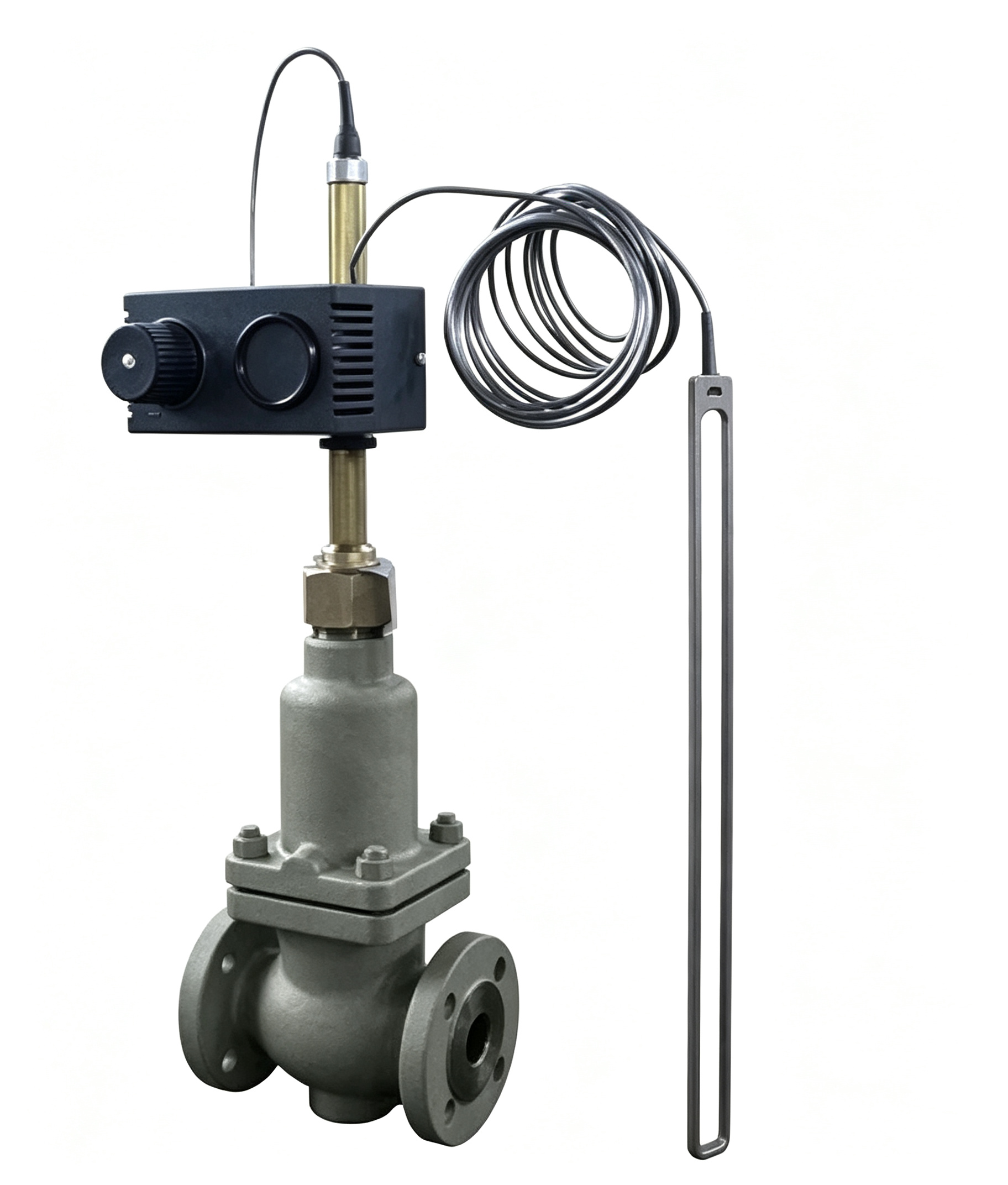
1. Product Overview
1.1 Product Description
The ZZYW Self-Operated Temperature Regulating Valve is designed for automatic temperature control in industrial and utility systems.
It operates without an external power source. The temperature-sensing element detects changes in the controlled medium, and the valve automatically adjusts its opening according to the preset temperature range.
The valve integrates temperature detection, regulation and actuation into one independent control system, making it suitable for applications where reliable automatic temperature control is required with a simple system configuration.
1.2 Customer Value
For customers, the ZZYW helps maintain more stable process temperature while reducing dependence on external control equipment.
Its self-operated design can simplify installation, reduce routine maintenance requirements and decrease the need for frequent manual adjustment.
For heating, cooling and heat-transfer systems, stable temperature control can also help improve process consistency and overall energy utilization.
2. Product Features
2.1 No External Power Required
The ZZYW is a self-operated temperature control valve and does not require an additional electrical or pneumatic power source for normal regulating operation.
This makes it suitable for locations where a simple and independent temperature-control solution is preferred.
2.2 Simple Structure
The valve has a relatively simple mechanical structure, which helps reduce maintenance workload.
For customers, this means fewer auxiliary components and easier system maintenance.
2.3 Continuously Adjustable Set Point
The required temperature can be continuously adjusted within the specified setting range.
This provides flexibility for different operating conditions and allows users to adapt the valve to changing process requirements.
2.4 Temperature Overload Protection
The valve is equipped with a temperature overload protection device.
This improves operational safety and helps protect the regulating system when abnormal temperature conditions occur.
2.5 Pressure-Balancing Structure
The valve adopts a pressure-balancing mechanism.
This helps reduce the influence of pressure differential on valve movement, improving regulating response and supporting more stable temperature control.
3. Working Principle
3.1 Temperature Detection
The temperature-sensing element monitors the temperature of the controlled medium.
When the temperature changes, the sensing element generates a corresponding mechanical response.
3.2 Automatic Valve Adjustment
The temperature signal is transmitted through the regulating mechanism to the valve.
The valve plug changes position automatically, increasing or decreasing the flow of the heating or cooling medium.
3.3 Temperature Stabilization
By adjusting the flow through the valve, the system changes the amount of heat transferred to or from the controlled process.
The valve continues to regulate until the process temperature approaches the preset value.
This allows automatic temperature control without continuous manual intervention.
4. Technical Parameters
4.1 Basic Specifications
| Parameter | Specification |
|---|---|
| Product Model | ZZYW |
| Product Type | Self-Operated Temperature Regulating Valve |
| Nominal Size | DN20–DN200 |
| Flow Coefficient Kv | 3.4–350 |
| Nominal Pressure | PN1.6 / 2.5 MPa |
| Pressure Class | ANSI 150 / 300 LB, JIS 10 / 20K |
| Set Value Deviation | ±2°C |
| Body Materials | Cast Iron, Cast Steel, Stainless Steel |
| Spool Materials | Stainless Steel |
| Temperature Package Material | Copper Nickel Plating |
| Connection | Flange |
The main technical parameters are specified for the ZZYW series shown on the product page.
4.2 Available Kv Values
Rated Kv values include:
3.4, 5.5, 11, 15, 20, 31, 52, 80, 122, 190, 300 and 350
depending on nominal valve size.
Correct sizing should be based on actual flow rate, temperature-control duty, pressure conditions and process medium.
4.3 Temperature Ranges
The ZZYW supports different temperature-control ranges for different applications.
Typical ranges include:
- Domestic hot water supply: 30–100°C
- Heating and central air-conditioning: 40–90°C
- Production process temperature control: 80–110°C
- Special applications: 120–180°C
5. Structure and Materials
5.1 Valve Body
Available body materials include:
- Cast Iron HT200 / QT450
- Cast Steel ZG230-450 / WCB
- Stainless Steel 304
- Stainless Steel 316
- Stainless Steel 316L
5.2 Valve Trim
Available spool materials include stainless-steel grades such as:
- 1Cr18Ni9Ti
- 1Cr18Ni12Mo2Ti
- 304
- 316
- 316L
Material selection should be based on process medium, temperature and corrosion conditions.
6. Applications and Customer Benefits
6.1 Heating Systems
The ZZYW can be used in heating systems to automatically regulate the flow of the heating medium and maintain a stable target temperature.
For customers, this helps reduce temperature fluctuations and supports more consistent heat delivery.
6.2 Central Air-Conditioning Systems
The valve is suitable for temperature regulation in central air-conditioning systems.
Automatic control can help maintain more stable operating conditions while reducing the need for manual adjustment.
6.3 Domestic Hot Water Systems
The ZZYW can be applied to hot-water supply systems where stable outlet temperature is required.
This helps improve temperature consistency and supports safer, more comfortable water supply conditions.
6.4 Industrial Production Processes
For industrial processes requiring stable thermal conditions, the valve can automatically regulate heating or cooling medium flow.
This helps reduce temperature variation and supports more consistent production conditions.
6.5 Reduced Maintenance and System Complexity
Because the valve integrates temperature sensing and automatic regulation into one system, it can reduce the number of external control components required.
For customers, this can mean:
- simpler installation
- fewer auxiliary components
- lower maintenance workload
- reduced manual adjustment
- more stable temperature control