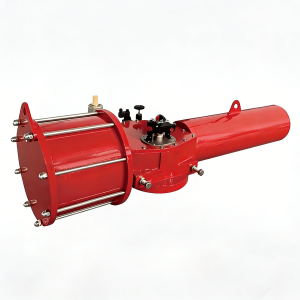
The types and structures of the regulating mechanisms of pneumatic actuators are roughly the same, with the main differences lying in the actuating mechanisms. Therefore, the introduction of pneumatic actuators is divided into two parts: the actuating mechanism and the control valve. A pneumatic actuator consists of two components: an actuating mechanism and a control valve (regulating mechanism). It generates a corresponding thrust according to the magnitude of the control signal to drive the control valve to operate. As the regulating part of the pneumatic actuator, the control valve produces a certain displacement or rotation angle under the thrust of the actuating mechanism, directly regulating the flow rate of the fluid.
- A pneumatic device is mainly composed of an air cylinder, piston, gear shaft, end cover, seals, screws, etc.; a complete set of pneumatic devices should also include components such as an opening indicator, stroke limiter, solenoid valve, positioner, pneumatic components, manual mechanism, and signal feedback unit.
- The connection dimensions between the pneumatic device and the valve shall comply with the provisions of ISO 5211 (bottom connection), GB/T 12222 and GB/T 12223.
- For pneumatic devices equipped with a manual mechanism, when the air supply is interrupted, the manual mechanism shall be available for opening and closing the pneumatic ball valve. When facing the handwheel, rotating the handwheel or handle counterclockwise opens the valve, and rotating it clockwise closes the valve.
- If the end of the piston rod is provided with internal and external threads, it shall have a wrench flat suitable for standard wrenches.
- The piston seals shall be easy to replace and maintain.
- For pneumatic devices with a buffer mechanism, the stroke length of the buffer mechanism may refer to the provisions in Table 1.
- For pneumatic devices with an adjustable buffer mechanism, there shall be an external mechanism on the cylinder block to adjust the buffering effect.
- The thread dimensions of the air inlet and outlet of the cylinder shall comply with the provisions of MANUR NORM (Attachment Standard) SYPV, GB/T 7306.1, GB/T 7306.2 and GB/T 7307.
Performance
- The rated output force or torque of the pneumatic device shall comply with the provisions of GB/T 12222 and GB/T 12223.
- Under no-load conditions, when air pressure specified in Table 2 is input into the cylinder, the device shall operate smoothly without jamming or creeping.
- At an air pressure of 0.6 MPa, the output torque or thrust of the pneumatic device in both opening and closing directions shall not be less than the value marked on the nameplate of the pneumatic device; besides, the device shall operate flexibly without permanent deformation or other abnormalities in any part.
- During the sealing test conducted at the maximum working pressure, the air leakage from the respective back pressure side shall not exceed (3 + 0.15D) cm³/min (standard conditions); the air leakage from the end cover and output shaft shall not exceed (3 + 0.15d) cm³/min.
- The strength test shall be carried out at 1.5 times the maximum working pressure. After maintaining the test pressure for 3 minutes, there shall be no leakage or structural deformation at the cylinder block, end cover and static sealing parts.
- For the service life test, the pneumatic device shall simulate the operation of a pneumatic valve. Under the condition of maintaining the output torque or thrust capacity in both directions, the number of opening and closing cycles shall not be less than 50,000 times (one opening-closing cycle counts as one time).
- For pneumatic devices with a buffer mechanism, there shall be no impact when the piston moves to the end position of the stroke.