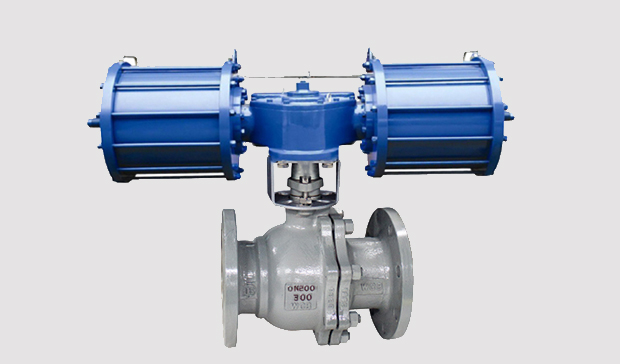
In industrial automation systems, valves play a pivotal role as core control components, and their performance is closely linked to supporting spare parts and scientific component selection. This blog will cover key topics including optional accessories for pneumatic valves, types of essential spare parts, actuator selection guidelines, and a detailed introduction to flange connection ball valves (two-piece and three-piece types), aiming to provide practical technical references for engineers and industry practitioners.
I. Optional Accessories for Pneumatic Valves
To meet specific operational requirements and enhance performance, pneumatic valves can be equipped with a range of optional accessories. The following are the most common and critical ones, along with their functions and application scenarios:
1. Valve Positioner
A valve positioner is a primary accessory for pneumatic actuators. It is used in conjunction with pneumatic actuators to improve the positional accuracy of the valve, overcome the impact of stem friction and unbalanced medium forces, and thus ensure the valve achieves accurate positioning according to the signal from the controller.
A positioner is required in the following cases:
-
When the medium pressure is high and the pressure difference is large;
-
When the control valve has a large diameter (DN > 100);
-
For high-temperature or low-temperature control valves;
-
When it is necessary to increase the action speed of the control valve;
-
When using a standard signal to operate an actuator with a non-standard spring (spring range outside 20~100KPa);
-
For split-range control applications;
-
When reversing the valve action (converting between air-to-close and air-to-open types);
-
When changing the flow characteristics of the valve (achievable by replacing the positioner cam);
-
For springless actuators or piston actuators that require proportional action;
-
When operating a pneumatic actuator with an electrical signal, an electro-pneumatic valve positioner is mandatory.
2. Solenoid Valve
When the system requires program control or two-position control, a solenoid valve must be equipped. When selecting a solenoid valve, in addition to considering AC/DC power supply, voltage, and frequency, special attention must be paid to the relationship between the solenoid valve and the action type of the control valve. Either “normally open” or “normally closed” types can be selected.
If it is necessary to increase the capacity of the solenoid valve to shorten the action time, two solenoid valves can be used in parallel, or the solenoid valve can be used as a pilot valve combined with a large-capacity pneumatic relay.
3. Air Filter Regulator
An air filter regulator is an accessory in industrial automation instruments. Its main functions are to filter and purify the compressed air from the air compressor and stabilize the pressure to the required value. It can be used as an air supply source and pressure stabilization device for various pneumatic instruments, solenoid valves, cylinders, spraying equipment, and small pneumatic tools.
4. Limit Switch (Position Transmitter)
A limit switch is a device that reflects the two extreme positions (fully open and fully closed) of the valve and sends out indication signals simultaneously. The control room can judge the on-off state of the valve based on these signals and take corresponding measures.
II. Essential Pneumatic Valve Spare Parts Types & Core Functions
During the entire application process of pneumatic valves, configuring essential auxiliary parts is usually necessary to enhance valve performance or improve operational efficiency. Common pneumatic valve spare parts include air filters, speed control valves, limit switches, electrical positioners, etc. In pneumatic technology, the assembly of three air source treatment components—air filter, pressure reducing valve, and lubricator—into one unit is called a pneumatic triplet. It is used to clean and filter the air entering pneumatic instruments and valves, and reduce the pressure to the rated working pressure supplied to the instruments, which is equivalent to the function of a transformer in a circuit.
Detailed classification of key spare parts and their functions:
-
Double-acting Pneumatic Actuator: Used for two-position control of valve opening and closing (double function, requiring air supply for both opening and closing actions).
-
Spring Return Actuator: In case of air supply cut-off or failure in the circuit, the valve automatically opens or closes (single function, relying on spring force for reset).
-
Single Solenoid Valve: The valve opens or closes when powered on, and closes or opens when powered off (explosion-proof type available).
-
Double Solenoid Valve: One coil energizes to open the valve, and the other coil energizes to close the valve; with memory function (explosion-proof type available).
-
Limit Switch Position Transmitter: Transmits the on-off position signal of the valve over long distances (explosion-proof type available).
-
Electrical Positioner: Adjusts and controls the medium flow of the valve according to the size of the current signal (standard 4-20mA) (explosion-proof type available).
-
Pneumatic Positioner: Adjusts and controls the medium flow of the valve according to the size of the air pressure signal (standard 0.02-0.1MPa).
-
Electropneumatic Transducer: Converts current signals into air pressure signals, used with pneumatic positioners (explosion-proof type available).
-
Pneumatic Air Treatment Triplet: Includes pressure reducing valve, filter, and lubricator; functions to stabilize pressure, clean, and lubricate moving parts of the pneumatic valve.
-
Manual Operation Mechanism: Allows manual operation of the valve when the automatic control system malfunctions.
III. Guidelines for Pneumatic Valve Spare Parts & Actuator Selection
Pneumatic valves are complex mechatronic instruments composed of various pneumatic components. Users need to make detailed selections based on control requirements. The key selection criteria are as follows:
-
Pneumatic Actuator: ① Double-acting type / ② Single-acting type / ③ Specification (matching valve size) / ④ Action time (response speed requirement).
-
Solenoid Valve: ① Single solenoid valve / ② Double solenoid valve / ③ Operating voltage (e.g., AC220V, DC24V) / ④ Explosion-proof requirement (if applicable to hazardous environments).
-
Signal Feedback: ① Mechanical switch / ② Proximity switch / ③ Output current signal (e.g., 4-20mA) / ④ Operating voltage / ⑤ Explosion-proof type (if needed).
-
Positioner: ① Electrical positioner / ② Pneumatic positioner / ③ Current signal range / ④ Air pressure signal range / ⑤ Need for electropneumatic transducer / ⑥ Explosion-proof requirement.
-
Pneumatic Air Treatment Triplet: ① Filter pressure reducing valve (core component for air source treatment) / ② Lubricator (selected based on whether the valve’s moving parts need lubrication).
-
Manual Operation Mechanism: Recommended for critical pipelines to ensure operability during system failures.