In industrial automation systems, valves play a pivotal role as core control components, and their performance is closely linked to supporting spare parts and scientific component selection. This blog will focus on two key themes: the types of pneumatic valve spare parts, motor (actuator) selection guidelines, and a detailed introduction to flange connection ball valves (two-piece and three-piece types), aiming to provide practical technical references for engineers and industry practitioners.
I. Pneumatic Valve Spare Parts Types & Core Functions
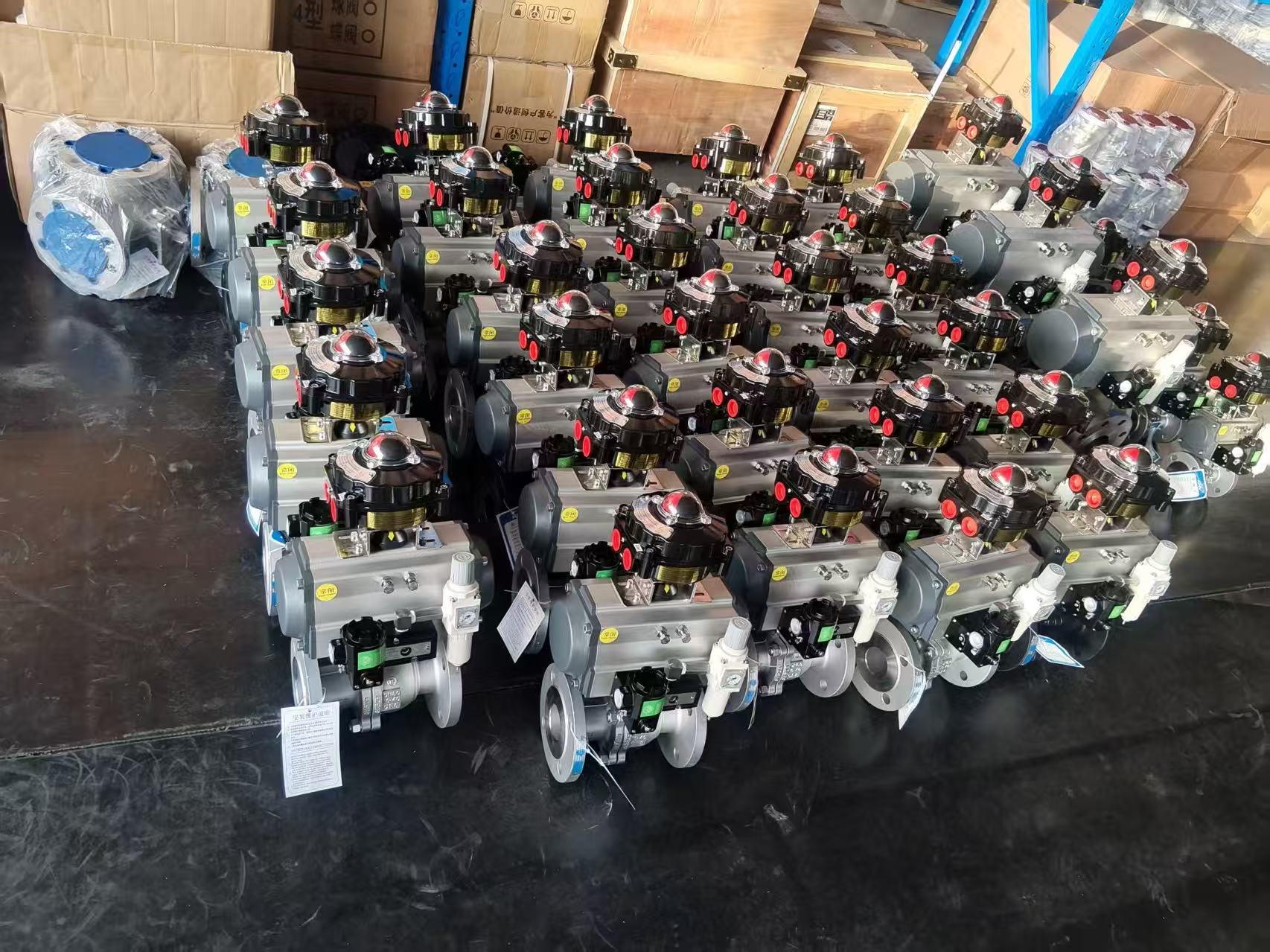
During the entire application process of pneumatic valves, it is usually necessary to configure some auxiliary parts to enhance valve performance or improve operational efficiency. Common pneumatic valve spare parts include air filters, speed control valves, limit switches, electrical positioners, etc. In pneumatic technology, the assembly of three air source treatment components—air filter, pressure reducing valve, and lubricator—into one unit is called a pneumatic triplet. It is used to clean and filter the air entering pneumatic instruments and valves, and reduce the pressure to the rated working pressure supplied to the instruments, which is equivalent to the function of a transformer in a circuit.
Detailed classification of key spare parts and their functions:
-
Double-acting Pneumatic Actuator: Used for two-position control of valve opening and closing (double function, requiring air supply for both opening and closing actions).
-
Spring Return Actuator: In case of air supply cut-off or failure in the circuit, the valve automatically opens or closes (single function, relying on spring force for reset).
-
Single Solenoid Valve: The valve opens or closes when powered on, and closes or opens when powered off (explosion-proof type available).
-
Double Solenoid Valve: One coil energizes to open the valve, and the other coil energizes to close the valve; with memory function (explosion-proof type available).
-
Limit Switch Position Transmitter: Transmits the on-off position signal of the valve over long distances (explosion-proof type available).
-
Electrical Positioner: Adjusts and controls the medium flow of the valve according to the size of the current signal (standard 4-20mA) (explosion-proof type available).
-
Pneumatic Positioner: Adjusts and controls the medium flow of the valve according to the size of the air pressure signal (standard 0.02-0.1MPa).
-
Electropneumatic Transducer: Converts current signals into air pressure signals, used with pneumatic positioners (explosion-proof type available).
-
Pneumatic Air Treatment Triplet: Includes pressure reducing valve, filter, and lubricator; functions to stabilize pressure, clean, and lubricate moving parts of the pneumatic valve.
-
Manual Operation Mechanism: Allows manual operation of the valve when the automatic control system malfunctions.
II. Guidelines for Pneumatic Valve Spare Parts & Motor (Actuator) Selection
Pneumatic valves are complex mechatronic instruments composed of various pneumatic components. Users need to make detailed selections based on control requirements. The key selection criteria are as follows:
-
Pneumatic Actuator: ① Double-acting type / ② Single-acting type / ③ Specification (matching valve size) / ④ Action time (response speed requirement).
-
Solenoid Valve: ① Single solenoid valve / ② Double solenoid valve / ③ Operating voltage (e.g., AC220V, DC24V) / ④ Explosion-proof requirement (if applicable to hazardous environments).
-
Signal Feedback: ① Mechanical switch / ② Proximity switch / ③ Output current signal (e.g., 4-20mA) / ④ Operating voltage / ⑤ Explosion-proof type (if needed).
-
Positioner: ① Electrical positioner / ② Pneumatic positioner / ③ Current signal range / ④ Air pressure signal range / ⑤ Need for electropneumatic transducer / ⑥ Explosion-proof requirement.
-
Pneumatic Air Treatment Triplet: ① Filter pressure reducing valve (core component for air source treatment) / ② Lubricator (selected based on whether the valve’s moving parts need lubrication).
-
Manual Operation Mechanism: Recommended for critical pipelines to ensure operability during system failures.
III. Flange Connection Ball Valves (Two-piece, Three-piece): A Complete Guide
1. Product Introduction
Flange connection ball valves (two-piece and three-piece types) are critical control components widely applied in various industrial pipeline systems, designed for on-off control and throttling adjustment of media. The two-piece and three-piece structural designs not only ensure the overall tightness and structural stability of the valve but also provide significant convenience for installation, maintenance, and disassembly.
Specifically, the two-piece flange ball valve features a compact structure, integrating the valve body and one end of the connection part, which is suitable for occasions with relatively simple working conditions and high requirements for space saving. The three-piece flange ball valve is composed of a middle valve body and two end covers; its detachable structure allows for easy removal of the middle valve body for maintenance or parts replacement without disassembling the entire pipeline, making it ideal for complex working conditions and frequent maintenance needs.
This series of ball valves is mainly made of carbon steel for key components, complemented by high-performance lining and sealing materials. It exhibits excellent corrosion resistance, pressure-bearing capacity, and wear resistance, and can be widely used in petroleum, chemical, metallurgy, water treatment, power generation, and other industries. It is suitable for various media such as water, oil, gas, and some corrosive fluids, effectively ensuring the safe and stable operation of the pipeline system.
2. Product Features
-
Superior Structural Design: The two-piece and three-piece structures are reasonably designed. The two-piece type has a compact size, small occupied space, and low flow resistance, ensuring efficient media circulation. The three-piece type enables separate disassembly and maintenance of the valve body, greatly reducing maintenance costs and downtime, and improving the operability of the equipment.
-
Excellent Sealing Performance: Adopting high-quality lining/seat materials such as PTFE (F4), PCTFE (F3), FEP (F46), and PO, combined with advanced sealing technology, the valve achieves reliable sealing under both positive and negative pressure conditions, effectively preventing media leakage and ensuring the safety of the production environment.
-
Strong Adaptability: With a nominal pressure range of PN0.6~1.6MPa and a nominal diameter range of DN15~350mm, it can meet the needs of different pipeline specifications and working pressure requirements. The carbon steel material used for the main components has good mechanical properties and toughness, adapting to various harsh working environments.
-
Easy Operation and Maintenance: The valve is available in multiple operation modes such as manual, pneumatic, worm gear, and electric, to meet the needs of different automation levels. The key components have standardized dimensions and interchangeability, facilitating quick replacement of wearing parts. Meanwhile, the smooth surface of the sphere reduces friction loss and extends the service life of the valve.
-
Compliance with Strict Standards: The design, manufacturing, structure length, flange size, pressure test, marking, and filling all comply with national and industry standards such as GB/T 12237, HG/T 3704, HG/T 20592, and GB/T 13927, ensuring the product’s quality and compatibility.
3. Technical Data (Carbon Steel)
3.1 Basic Parameters
Nominal Pressure: PN0.6~1.6 (MPa)
Nominal Diameter: DN15~350 (mm)
Valve Type: Two-piece/Three-piece flange connection ball valve (floating ball type)
3.2 Floating Ball Valve Torque (Carbon Steel, Pressure: 1.6MPa)
|
Caliber (DN)
|
Stresses (MPa)
|
Torques (N·m)
|
|---|---|---|
|
15
|
1.6
|
14
|
|
20
|
1.6
|
14
|
|
25
|
1.6
|
14
|
|
32
|
1.6
|
22
|
|
40
|
1.6
|
23
|
|
50
|
1.6
|
34
|
|
65
|
1.6
|
69
|
|
80
|
1.6
|
89
|
|
100
|
1.6
|
171
|
|
125
|
1.6
|
318
|
|
150
|
1.6
|
432
|
|
200
|
1.6
|
665
|
|
250
|
1.6
|
1245
|
|
300
|
1.6
|
2495
|
3.3 Implementation Standards
|
Item
|
Standard Number
|
|---|---|
|
Design and Manufacturing
|
GB/T 12237
|
|
Structure Length
|
HG/T 3704
|
|
Flange Size
|
HG/T 20592
|
|
Pressure Test
|
GB/T 13927
|
|
Symbolize
|
GB/T 12220
|
|
Fill
|
JB/T 7928
|
3.4 Basic Model (Fully Lined, Carbon Steel Base Material)
|
Operation Mode
|
Model
|
Lining Feature
|
|---|---|---|
|
Manually
|
Q41F4, Q41PFA, Q41F46
|
Full Lining
|
|
Pneumatic
|
Q641F4, Q641PFA, Q641F46
|
Full Lining
|
|
Worm-gear Rotation
|
Q341F4, Q341PFA, Q341F46
|
Full Lining
|
|
Electricity
|
Q941F4, Q941PFA, Q941F46
|
Full Lining
|
3.5 Main Parts and Components Material Table (Carbon Steel)
|
Serial Number
|
Part Name
|
Carbon Steel Material
|
Note
|
|---|---|---|---|
|
1
|
Valve Body, Valve Cover
|
WCB
|
–
|
|
2
|
Sphere
|
WCB
|
–
|
|
3
|
Lining/Seat
|
PT, FE(F₄), PCTFE(F3), FEP(F46), PO
|
Lining materials for corrosion resistance
|
|
4
|
Packing Gland
|
WCB
|
–
|
|
5
|
Packing Material
|
PTFE(F4) Polytetrafluoroethylene
|
High-temperature and corrosion-resistant
|
|
6
|
Stem
|
WCC
|
Transmits operation torque
|
IV. Summary
The performance of pneumatic valves depends not only on the quality of the valve itself but also on the rational selection of spare parts and actuators. Understanding the types and functions of spare parts helps to optimize the valve system configuration. For flange connection ball valves, their structural advantages and wide adaptability make them an important choice in industrial pipelines. Whether selecting pneumatic valve accessories or choosing flange ball valves, adhering to technical standards and matching actual working conditions is the key to ensuring stable and efficient operation of the system.