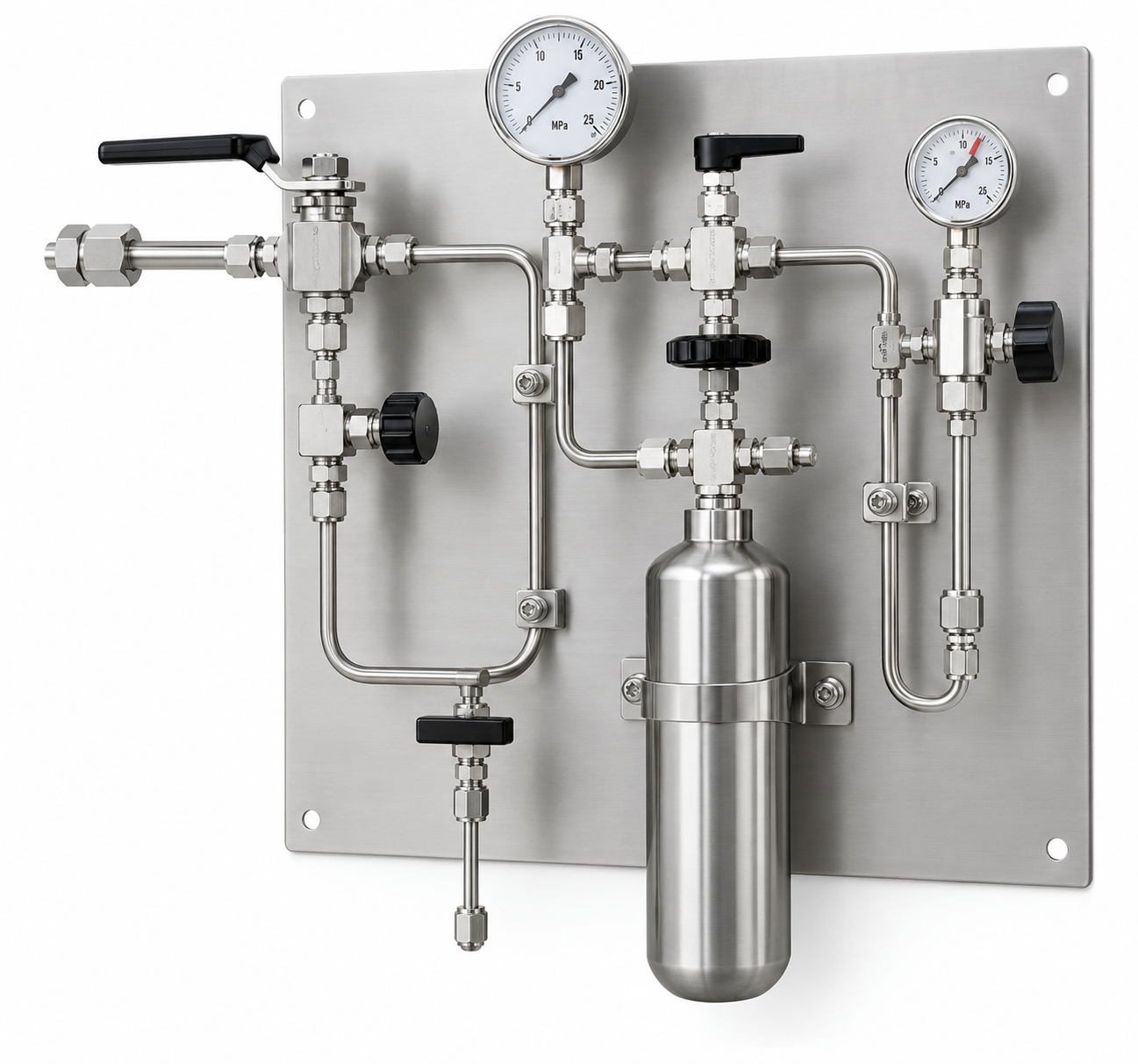
I. Product Overview
1.1 Product Description
The Closed Loop Sampling System is designed for safe and representative sampling of liquids, gases, and process media from pipelines, vessels, and process equipment while minimizing operator exposure and uncontrolled release to the atmosphere.
Unlike conventional open sampling methods, a closed-loop system keeps the process medium contained within the sampling circuit and sample container during sampling. This makes it particularly suitable for chemical, petrochemical, refinery, oil & gas, and other industrial processes involving hazardous, toxic, flammable, or volatile media.
The system can be configured with sampling valves, tubing, fittings, purge connections, sample cylinders or bottles, pressure-control components, and other accessories according to the actual process conditions.
1.2 Closed-Loop Sampling Principle
A closed-loop sampling system withdraws a portion of the process medium from the process line and directs it through a controlled sampling circuit.
Depending on the configuration, the medium may circulate through the sampling loop before returning to the process, helping keep the sample line fresh and improving sample representativeness. In cylinder-based systems, the sample is isolated inside a pressure-rated sample cylinder before removal for laboratory analysis.
This arrangement reduces the need to vent process media directly to atmosphere during sampling.
1.3 Designed for Safer Process Sampling
Closed-loop sampling is particularly useful where conventional open sampling could expose operators to hazardous vapors, toxic chemicals, flammable media, or high-pressure process fluids.
By maintaining containment during sample collection, the system can help reduce operator exposure, spills, vapor release, and process emissions while supporting consistent sample collection.
II. Product Features
2.1 Closed Sampling for Improved Safety
The sampling process is carried out within a contained flow path, reducing direct contact between the operator and the process medium.
This is especially important when sampling toxic, corrosive, volatile, flammable, or otherwise hazardous chemicals.
2.2 Representative Sample Collection
For reliable laboratory analysis, the sample should reflect the actual process conditions as closely as practical.
Closed-loop systems can be designed with continuous circulation or bypass flow so that fresh process medium remains available at the sampling point before the sample is isolated.
2.3 Reduced Emissions
Compared with traditional sampling methods that may require process fluid or vapor to be vented during flushing and filling, a properly designed closed-loop system can reduce uncontrolled emissions.
This can be particularly valuable in petrochemical and chemical plants where VOC emissions and hazardous vapor exposure need to be controlled.
2.4 Bottle or Cylinder Sampling Options
The system can be configured for different sample collection methods.
Bottle sampling may be suitable for certain low-vapor-pressure liquids that can be safely collected at or near atmospheric pressure.
Cylinder sampling is more suitable where the sample needs to remain contained under pressure or where gas, liquefied gas, volatile liquid, or two-phase media must be preserved for transport and analysis.
2.5 Purging and Flushing Options
Purge and flushing arrangements can be incorporated according to the process requirements.
Nitrogen or another suitable purge medium may be used where required to clear the sampling path, reduce residual process material, or prepare the system for the next sampling operation.
2.6 Customizable System Configuration
Closed-loop sampling systems are normally engineered according to the actual process conditions rather than supplied as one universal configuration.
Valve arrangement, tubing size, sample container, pressure rating, purge method, materials, and accessories can be selected to suit the customer’s medium and operating conditions.
III. Typical Applications
3.1 Chemical Processing
The system can be used for sampling acids, solvents, hydrocarbons, chemical intermediates, and other process fluids where controlled containment is required.
3.2 Petrochemical and Refinery
Typical applications include process sampling in refinery units, petrochemical production lines, storage and transfer systems, and other hydrocarbon services.
Closed-loop sampling systems are particularly useful where volatile organic compounds or hazardous vapors must be controlled during sampling.
3.3 Oil and Gas
The system can be used for gas, liquid hydrocarbon, condensate, and other oil and gas process sampling applications.
Depending on the medium, a sealed sample cylinder may be used to maintain the sample under pressure during collection and transportation.
3.4 Toxic and Hazardous Media
For toxic or highly hazardous media, closed sampling helps reduce the possibility of direct operator contact.
The actual system design should be selected according to the toxicity, corrosiveness, vapor pressure, process pressure, and other properties of the medium.
3.5 Gas and Liquefied Gas Sampling
Specialized configurations can be used for gas and liquefied gas sampling where maintaining sample containment and pressure is important.
Cylinder-based sampling systems are commonly used for these applications.
IV. System Configuration
4.1 Sampling Valve
The sampling valve controls the extraction and routing of process media through the sampling circuit.
Depending on the system design, ball valves, needle valves, switching valves, or dedicated sampling valves may be used.
4.2 Sample Cylinder
A pressure-rated sample cylinder can be used when the process medium needs to remain contained under pressure.
This configuration is commonly suitable for gas, volatile liquid, liquefied gas, and other pressure-sensitive samples.
4.3 Sample Bottle
For suitable liquid applications, a bottle can be used as the sample receiver.
Bottle configuration should be selected according to the vapor pressure, toxicity, temperature, and chemical compatibility of the sampled medium.
4.4 Tubing and Fittings
Tubing and fittings form the contained flow path between the process connection, sampling valves, and sample receiver.
Materials and pressure ratings should be selected according to the process medium and design conditions.
4.5 Purge Connection
A purge connection can be incorporated where nitrogen or another compatible purge gas is required.
The purge arrangement can assist with clearing the sample line or preparing the system for subsequent operation.
4.6 Pressure Protection
Depending on the process and sample receiver, pressure gauges, relief devices, rupture discs, regulators, or other protection components can be incorporated into the system.
These devices must be selected according to the applicable design pressure and project safety requirements.
V. Product Advantages
5.1 Reduced Operator Exposure
The closed sampling arrangement limits direct contact between personnel and the sampled medium, providing an important advantage when handling hazardous chemicals and process gases.
5.2 Better Emission Control
Containing the medium during sampling can help reduce atmospheric release of hydrocarbons, VOCs, and other hazardous vapors.
5.3 Improved Sampling Consistency
A properly configured sampling loop helps ensure that fresh process medium reaches the sampling point before the sample is captured.
This can improve consistency and help reduce errors caused by stagnant material remaining in the sampling line.
5.4 Safer Sample Transfer
When a sealed sample cylinder is used, the sample can remain contained during removal and transport to the laboratory.
This is particularly useful for gas, volatile liquid, or hazardous process samples.
5.5 Adaptable to Different Process Conditions
The system can be configured according to different pressures, temperatures, media, sampling frequencies, sample volumes, and plant operating procedures.
This allows customers to obtain a sampling solution matched to the actual application rather than adapting the process to a fixed standard unit.
VI. Technical Parameters
6.1 General Specifications
| Item | Specification |
|---|---|
| Product Name | Closed Loop Sampling System |
| Function | Representative Process Sampling |
| Applicable Media | Gas / Liquid / Process Chemicals |
| Sample Receiver | Bottle / Pressure-Rated Cylinder |
| Operation | Manual / Configured According to Project |
| System Type | Closed Loop / Bypass / Customized |
| Process Connection | According to Project Requirements |
| Material | Selected According to Process Medium |
| Pressure Rating | According to Process Conditions |
| Operating Temperature | According to Process Conditions |
| Purge Connection | Optional |
| Continuous Circulation | Available According to Configuration |
| Pressure Protection | Available According to Configuration |
| Custom Design | Available |
6.2 Optional Components
Depending on project requirements, the system can be equipped with:
- Sampling valves
- Isolation valves
- Switching valves
- Needle valves
- Sample cylinders
- Sample bottles
- Purge connections
- Pressure gauges
- Pressure regulators
- Relief valves
- Rupture discs
- Flow indicators
- Tubing and fittings
- Protective enclosure or mounting panel
VII. Selection and Project Support
7.1 Process Information Required
For correct system selection, customers are recommended to provide:
- Process medium
- Chemical composition
- Operating pressure
- Design pressure
- Operating temperature
- Design temperature
- Liquid, gas, or two-phase condition
- Required sample volume
- Sampling frequency
- Process connection
- Available return connection
- Purging requirements
- Required sample container
7.2 Sample Container Selection
The sample receiver should be selected according to the physical properties of the process medium.
Low-vapor-pressure liquids may be suitable for bottle collection in an appropriate system, while gases, volatile liquids, liquefied gases, and pressure-sensitive samples are generally better suited to sealed pressure-rated cylinders.
7.3 System Design According to Process Conditions
Not every closed-loop sampling system uses the same flow arrangement.
Where a suitable pressure differential is available, the sample loop can be designed to circulate process fluid and return it to a lower-pressure point. Other applications may use different sampling arrangements depending on the vessel, pipeline, or process equipment.
7.4 Customized Sampling Solution
For chemical, petrochemical, refinery, and oil & gas projects, the complete sampling system can be configured according to the customer’s actual operating conditions.
By matching the sampling valves, process connections, sample receiver, tubing, purge system, pressure protection, and operating sequence, the system can provide a safer and more practical method for collecting representative process samples.