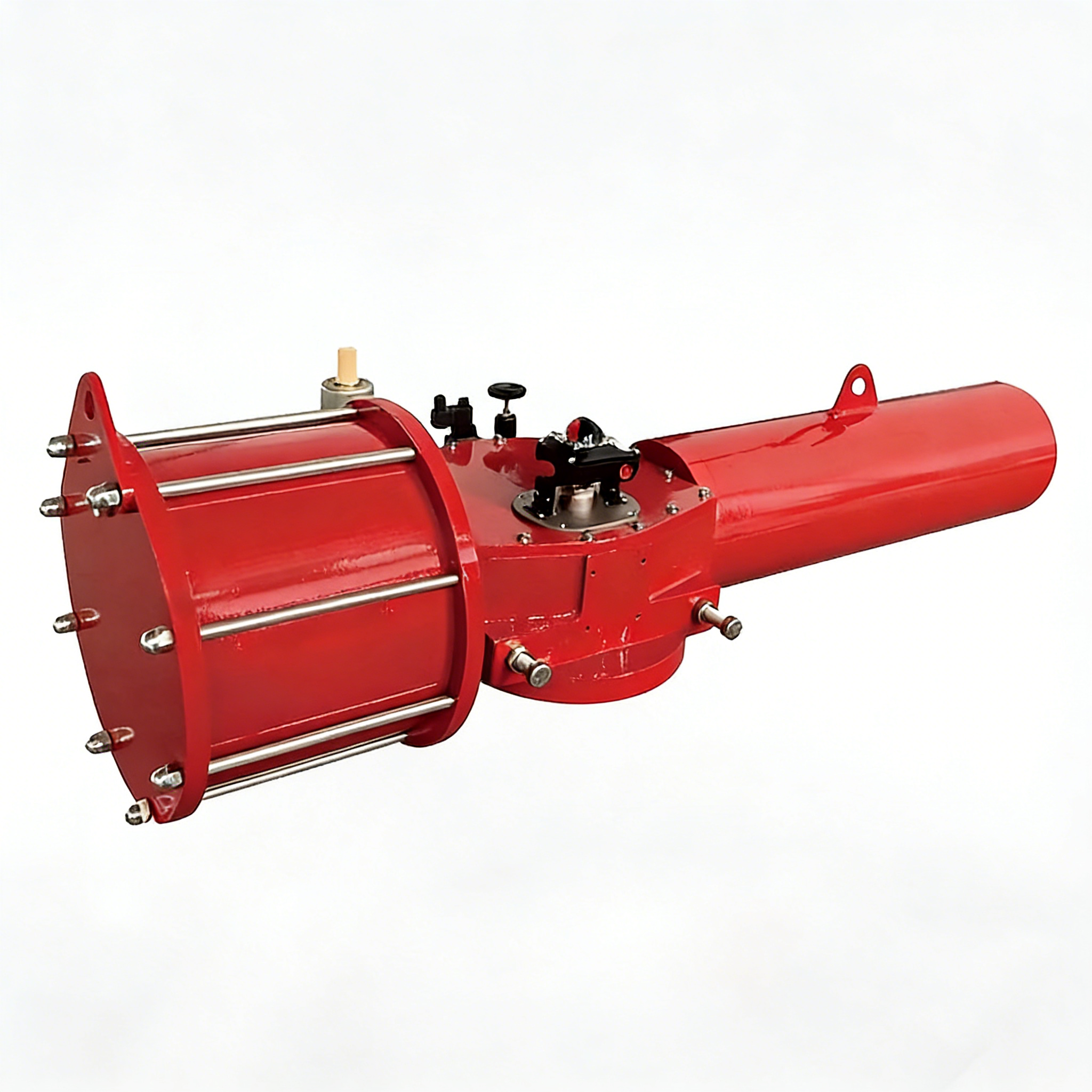
Pneumatic actuators are critical components in industrial valve automation, converting compressed air into mechanical motion to control the opening and closing of valves. Among the various types available, single-acting and double-acting pneumatic actuators are the most widely used—each designed for specific operational requirements and safety scenarios. In this blog, we’ll dive into their core differences, installation best practices, and essential accessories, with a focus on the AW series pneumatic actuator—a reliable solution for 90° rotary valves.
Overview of the AW Series Pneumatic Actuator
The AW series pneumatic actuator is engineered for 90° rotary (1/4-turn) valves, including ball valves, butterfly valves, and plug valves. Manufactured in compliance with JIS standards, it features an ISO5211 international standard connection interface for seamless integration with valves. To ensure optimal performance, proper selection and installation are paramount—let’s start with the key selection criteria.
How to Select the Right AW Series Actuator
-
Determine Valve Torque
Calculate the required torque based on the valve type and pipeline medium, then apply the following safety margins:
- Steam or non-lubricated media: Add 25% safety margin
- Non-lubricated dry gas: Add 60% safety margin
- Non-lubricated gas-transported granular materials: Add 100% safety margin
- Clean, friction-free lubricated media: Add 20% safety margin
-
Match Air Supply Pressure
Refer to the double-acting or single-acting torque table corresponding to your system’s air supply pressure to select the exact actuator model.
Critical Installation Precautions
The accuracy of the installation between the pneumatic actuator and the valve directly impacts operational safety and service life. Follow these guidelines:
- Coaxial Alignment: Ensure absolute coaxiality between the actuator’s central shaft and the valve stem for smooth operation.
- Torque Verification: Test the valve’s torque before assembly to ensure it does not exceed the actuator’s rated capacity.
- Post-Assembly Testing:
- Pressurize the valve to its rated sealing pressure.
- Supply air to the actuator at 0.4–0.7MPa (or customer-specified pressure), switching air intake between the two ports.
- Observe the valve’s opening and closing performance—no hesitation, crawling, or jamming is allowed. The valve should rotate flexibly.
- Conduct multiple repeated tests to validate reliability.
Single-Acting vs Double-Acting Pneumatic Actuators: Core Differences
The primary distinction lies in their operating principles, reset mechanisms, and application scenarios:
Double-Acting Pneumatic Actuators
- Operation: Requires compressed air to both open and close the valve. Air pressure drives the piston in one direction to open the valve, and air pressure on the opposite side closes it (cylinder-driven reset).
- Failure Mode: In the event of air supply loss, the actuator remains in its current position (no automatic reset).
- Key Advantages: No internal springs, resulting in lower manufacturing costs and higher torque output for the same size.
- Typical Applications: General industrial scenarios where automatic reset is not required, such as standard fluid handling systems.
Single-Acting Pneumatic Actuators
- Operation: Uses compressed air to drive one direction (e.g., open the valve), with a built-in spring for automatic reset when air supply is cut off.
- Two Types:
- Normally Open (NO): Closes on air supply, opens on air loss.
- Normally Closed (NC): Opens on air supply, closes on air loss.
- Failure Mode: Automatically resets to the default position (open/closed) without air pressure.
- Key Advantages: Enhanced safety for hazardous environments—ideal for systems transporting flammable gases or liquids. In emergencies (e.g., air supply failure), the actuator resets automatically to minimize risks.
- Typical Applications: Hazardous working conditions requiring fail-safe functionality, such as petrochemical plants or gas transmission pipelines.
Functions & Uses of Pneumatic Actuators & Accessories
To expand the actuator’s capabilities and adapt to diverse industrial needs, the following accessories are commonly used:
| Accessory | Function & Application |
|---|---|
| Double-Acting Actuator | Two-position control (full open/full close) for valves. |
| Spring-Return Actuator | Automatic valve opening/closing in case of power/air supply cutoff or system failure. |
| Single-Solenoid Valve | Valve opens/closes on power supply, resets on power loss (explosion-proof version available). |
| Double-Solenoid Valve | One coil opens the valve, the other closes it—features memory function (explosion-proof version available). |
| Limit Switch Feedback Device | Transmits valve position signals remotely (explosion-proof version available). |
| Electropneumatic Positioner | Regulates medium flow based on standard 4-20mA current signals (explosion-proof version available). |
| Pneumatic Positioner | Regulates medium flow based on standard 0.02-0.1MPa air pressure signals. |
| Current-to-Pressure Transducer | Converts current signals to air pressure signals for use with pneumatic positioners (explosion-proof version available). |
| Air Source Treatment Unit (Regulator + Filter + Lubricator) | Stabilizes air pressure, filters impurities, and lubricates moving parts. |
| Manual Override Mechanism | Enables manual operation when automatic control malfunctions. |
Conclusion
Choosing between single-acting and double-acting pneumatic actuators depends on your system’s safety requirements, failure-mode needs, and cost considerations. The AW series actuator, with its JIS and ISO5211 compliance, offers reliable performance for 90° rotary valves across various industries. By following proper selection and installation procedures, and equipping the actuator with suitable accessories, you can ensure efficient, safe, and long-lasting valve automation.
For personalized recommendations or technical support regarding the AW series pneumatic actuators, feel free to contact our team!