No valve is simpler to operate than a ball valve: one effortless 90-degree turn switches it from fully open to fully shut, faster than any other valve type. Yet beneath that satisfying twist lies a surprisingly dramatic story, because the very speed that makes it so convenient can also destroy a pipeline.
Imagine a long pipe carrying water at high velocity. The moment the ball snaps shut, the moving liquid has nowhere to go. It slams into the closed sphere, sending a pressure wave racing backward at roughly 1,400 meters per second, the speed of sound in water. This phenomenon, called water hammer, can momentarily spike pressure to several times the system’s working rating, enough to burst pipes and crack fittings. Professional engineers therefore never simply “pick a valve”: they calculate line length, closing time, and surge pressure, and may even install slow-closing actuators to soften the blow. Speed is a feature, and a risk, in one package.
Compared with multi-turn gate valves that demand many laborious rotations, the ball valve needs only a quarter turn and remarkably low torque, which is why it appears everywhere from kitchen faucets to offshore platforms. Here is a second surprise: an ordinary ball valve secretly relies on the pressure it controls. In a “floating ball” design, the ball is held loosely between two seats, and fluid pressure itself pushes the ball against the downstream seat to create the seal. The harder the pressure, the tighter the seal, an elegant trick that works beautifully at household scale. But on giant pipelines, where the ball can weigh tonnes and the drag of rushing fluid is enormous, engineers switch to a “trunnion-mounted” design in which the ball is anchored by a stem, so that the upstream seat, rather than brute force, does the sealing work. Same quarter-turn, entirely different physics.
Rotating the ball also wipes the seat surface clean, letting the valve shrug off the debris that would jam a gate valve. The true genius, however, sits in the seat rings. Soft PTFE seats deliver near-bubble-tight shutoff but fear heat; metal seats brave steam, abrasive slurries, and high temperatures; and fire-safe valves carry a secondary metal seat that quietly takes over if the soft ring burns away. One valve, three personalities, chosen seat by seat.
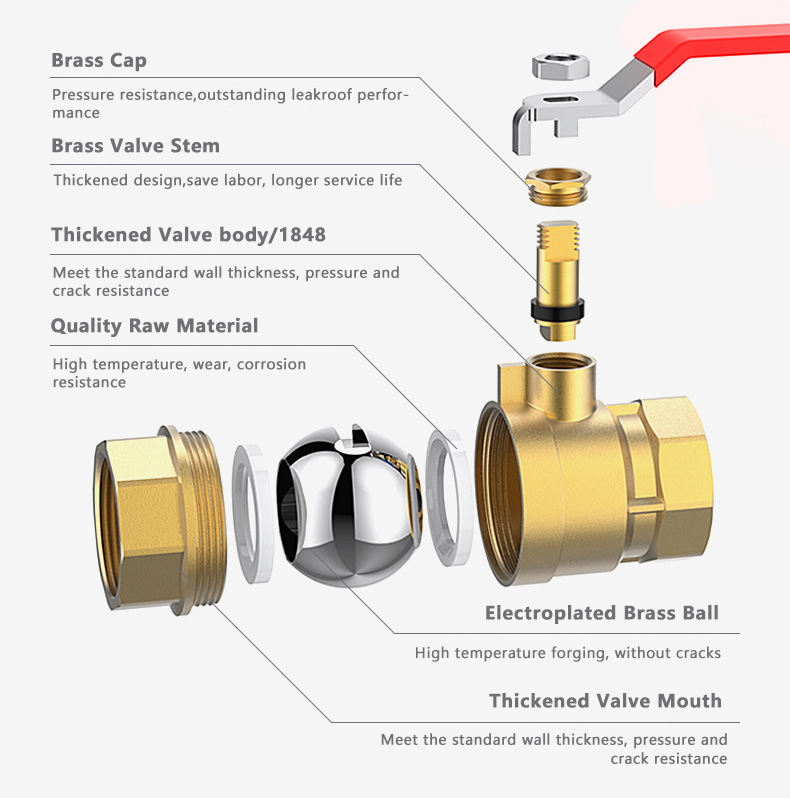
Materials tell their own story, from chrome-plated brass in home plumbing to duplex stainless steel, exotic nickel alloys, and even ceramic-coated balls for corrosive chemical duty, while cryogenic ball valves hold LNG at minus 196 degrees Celsius. Precision is unforgiving: the ball’s spherical surface must be machined and lapped to sub-micron smoothness, because a single microscopic scratch becomes a permanent leak path.
Finally, the quarter-turn geometry makes ball valves perfect for automation. Pneumatic or electric actuators bolt on in minutes, transforming the humble handle into a smart node equipped with position feedback, remote control, and predictive maintenance. The oldest idea in the valve world, a ball that simply rotates, is quietly becoming one of the most connected.