
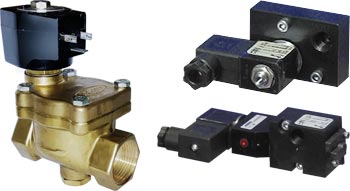
Solenoid valves operate using a linear sliding obstructer that opens and closes the valve, or changes the flow from one outlet to another. There are many different types of obstructers used including plunger, shuttle, spool, and diaphragm.
The linear motion is achieved by energizing an electromagnetic coil to pull the obstructer in one direction. A spring drives the obstructer back in the opposing direction when the coil is de-energized. 2-position on/off valves are the most common type of solenoid valves, but there are a vast number of others, including 3-position where there are 2 coils that pull the obstructer in opposite directions, using springs to center it when neither is energized.
There are even proportional solenoid valves that can be used for flow control. In these valves, the coil moves the obstructer varying distances based on the voltage supplied to it.
Solenoid valves are relatively small. Their size is limited by the strength of the coil which is a result of the windings used to create a magnetic field when energized. In addition to the limit on strength of the coil, the flow paths and orifices in solenoid valves are rather small when compared to the line size. This limits flow and increases the pressure drop through the valve.

Common everyday applications include the water line on dishwashers and ice makers. In industrial valve automation, solenoid valves are also used to control the supply air to pneumatic actuators.
If a high flow rate or small pressure drop is required, solenoid valves are not suitable. Coaxial or angle seat valves are required.
Most solenoid valves consist of a valve body on which various coil types can be attached. The coils come in a range of voltages with a variety of connectors, and electrical protection ratings.
